Welcome to the JAZZSCORE home page.
Please click on the links provided to access the official websites of New Zealand artists Alloy, Bluespeak, Bongo Nation, Cosa, the Inner City Jazz Workshop, Tom Ludvigson and Trip to the Moon.
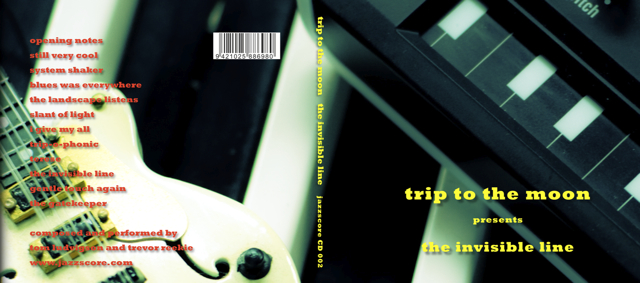
TRIP TO THE MOON
NEW ALBUM RELEASED 2011 ON JAZZSCORE CD
THE INVISIBLE LINE

Photo by Michael Flynn
*
THE SONGS
none of us know anything
None of us know anything (we just make it up as we go along): A quote from Jac Holzman, the founder of Elektra Records when he was interviewed for Radio NZ. This track also features percussion from the Bedouin Jerry Can Band who were on their way to Womad in 2009. Trevor went out to the motel out at Mangere Airport and recorded an interview as well as an impromptu performance in the Motel Conference Room with 2 hand held microphones. The Jerry Can Band didn’t actually have their Jerry Cans so they used plastic chairs and milk crates. Such generous delightful people. Also featured on this track is a bass sample from Pete Scott who often plays with Tom in Bluespeak and the Inner City Jazz Ensemble. Edwina Thorne performs on trumpet.
the system shaker
The system shaker: The famous line ‘I know how the system works. I’m against the system” is a quote from A former Swiss banker who passed on data containing account details of 2,000 prominent people to Wikileaks founder Julian Assange. The data was held on two discs handed over by Rudolf Elmer at a press conference in London. Mr Elmer is on trial in Switzerland for breaking bank secrecy laws. The Wikileaks websites is a defining websites that endorses the belief that we are indeed living in the future. The track evolved from a rhythm loop created by Tom and a guitar part that Tom recorded unbeknownst to Trevor who was jamming along whilst looking for a guitar sound - It ended up being the final performance. Once again a bass line from Pete Scott.
blues was everywhere
Blues was everywhere: This a line delivered by jazzman Mose Allison in a Radio NZ interview. Mose was not only known for his skills as a pianist, but also his way with words earned him the reputation as "the William Faulkner of jazz”. This is a track that went thru a number of re works before it’s final mix. It features the ever excellent Nigel Gavin on Glissantar, a fretless 12 string cross between a guitar and an Oud. The track was then emailed to Greg Johnson in Los Angeles who blew the trumpet track in his home studio and emailed it back. Greg has contributed regularly to Trip to the Moon albums. Greg had sung and played trumpet for Tom’s band Bluespeak whilst Trevor was a member of Greg’s band for 10 years playing on four of his studio albums for Pagan and EMI.
lucifer's intermission
Lucifer's intermission: This is actually 3 different compositions condensed into one. The slow section came about from Tom playing an Erik Satie type ambient piece with Trevor providing samples from sources he refuses to reveal. … it was then shaped with a wall of ebo guitars from Trevor and later Nigel Gavin contributed an awesome Glissantar performance that just nails it together. The Devils Interlude refers to the tritone - a musical interval that spans three whole tones. Originally it was often used as the main interval of dissonance in Western harmony. The name diabolus in musica ("the Devil in music") has been applied to the interval from at least the early 18th century. It totally freaked the western ancients out. The tritone substitution is one of the most common chord and improvisation devices in jazz.
still very cool
Still very cool: A groove put together by Tom with Jim Langabeer contributing his saxophone …
illegitimi non carborundum
Illegitimi non Carborundum: This is the first completed track made for this album. It features a 12 string acoustic riff from Trevor, some dazzling jazz runs from Tom and a percussion track provided by Ian Chapman aka Dr Glam from Otago Uni. Ian is currently a lecturer at Otago University’s Contemporary Music Course. His passion for all things percussive led him to the Hang (pronounced hung) drums ….
every show i do
Every show I do: The voice sample comes from a discussion Trevor had with Detroit Soul Ambassador Melvin Davis. The basic riff for the track came from a line played by Trevor on Tom’s Ukulele. It grew from there including some stellar melodica played by Tom. Ask Trevor about this track and he will tell you that it sounds the closest riff to a Car Crash Set song that he’s played since he left Car Crash Set.
eleven strings and a soprano
Eleven strings and a soprano: 11 string acoustic tuned into an open Dm sets the tone for a composition put together by Tom and a sopranino sax track from Jim Langabeer again. The thought behind this composition refers to the wrestling of the idea. The holding of the note.
the invisible line
The Invisible Line: a languid piano composition from Tom with Trevor contributing an FX track with his Indian Raagini and oddball noises.
curfew
Curfew: This one is dedicated to the protests in Egypt. the voice sample in this track comes from the late Harry Beckett. A wonderful jazz musician. The Oud was played Haitham Mazyan.
none of us know anything
None of us know anything (we just make it up as we go along): A quote from Jac Holzman, the founder of Elektra Records when he was interviewed for Radio NZ. This track also features percussion from the Bedouin Jerry Can Band who were on their way to Womad in 2009. Trevor went out to the motel out at Mangere Airport and recorded an interview as well as an impromptu performance in the Motel Conference Room with 2 hand held microphones. The Jerry Can Band didn’t actually have their Jerry Cans so they used plastic chairs and milk crates. Such generous delightful people. Also featured on this track is a bass sample from Pete Scott who often plays with Tom in Bluespeak and the Inner City Jazz Ensemble. Edwina Thorne performs on trumpet.
the system shaker
The system shaker: The famous line ‘I know how the system works. I’m against the system” is a quote from A former Swiss banker who passed on data containing account details of 2,000 prominent people to Wikileaks founder Julian Assange. The data was held on two discs handed over by Rudolf Elmer at a press conference in London. Mr Elmer is on trial in Switzerland for breaking bank secrecy laws. The Wikileaks websites is a defining websites that endorses the belief that we are indeed living in the future. The track evolved from a rhythm loop created by Tom and a guitar part that Tom recorded unbeknownst to Trevor who was jamming along whilst looking for a guitar sound - It ended up being the final performance. Once again a bass line from Pete Scott.
blues was everywhere
Blues was everywhere: This a line delivered by jazzman Mose Allison in a Radio NZ interview. Mose was not only known for his skills as a pianist, but also his way with words earned him the reputation as "the William Faulkner of jazz”. This is a track that went thru a number of re works before it’s final mix. It features the ever excellent Nigel Gavin on Glissantar, a fretless 12 string cross between a guitar and an Oud. The track was then emailed to Greg Johnson in Los Angeles who blew the trumpet track in his home studio and emailed it back. Greg has contributed regularly to Trip to the Moon albums. Greg had sung and played trumpet for Tom’s band Bluespeak whilst Trevor was a member of Greg’s band for 10 years playing on four of his studio albums for Pagan and EMI.
lucifer's intermission
Lucifer's intermission: This is actually 3 different compositions condensed into one. The slow section came about from Tom playing an Erik Satie type ambient piece with Trevor providing samples from sources he refuses to reveal. … it was then shaped with a wall of ebo guitars from Trevor and later Nigel Gavin contributed an awesome Glissantar performance that just nails it together. The Devils Interlude refers to the tritone - a musical interval that spans three whole tones. Originally it was often used as the main interval of dissonance in Western harmony. The name diabolus in musica ("the Devil in music") has been applied to the interval from at least the early 18th century. It totally freaked the western ancients out. The tritone substitution is one of the most common chord and improvisation devices in jazz.
still very cool
Still very cool: A groove put together by Tom with Jim Langabeer contributing his saxophone …
illegitimi non carborundum
Illegitimi non Carborundum: This is the first completed track made for this album. It features a 12 string acoustic riff from Trevor, some dazzling jazz runs from Tom and a percussion track provided by Ian Chapman aka Dr Glam from Otago Uni. Ian is currently a lecturer at Otago University’s Contemporary Music Course. His passion for all things percussive led him to the Hang (pronounced hung) drums ….
every show i do
Every show I do: The voice sample comes from a discussion Trevor had with Detroit Soul Ambassador Melvin Davis. The basic riff for the track came from a line played by Trevor on Tom’s Ukulele. It grew from there including some stellar melodica played by Tom. Ask Trevor about this track and he will tell you that it sounds the closest riff to a Car Crash Set song that he’s played since he left Car Crash Set.
eleven strings and a soprano
Eleven strings and a soprano: 11 string acoustic tuned into an open Dm sets the tone for a composition put together by Tom and a sopranino sax track from Jim Langabeer again. The thought behind this composition refers to the wrestling of the idea. The holding of the note.
the invisible line
The Invisible Line: a languid piano composition from Tom with Trevor contributing an FX track with his Indian Raagini and oddball noises.
curfew
Curfew: This one is dedicated to the protests in Egypt. the voice sample in this track comes from the late Harry Beckett. A wonderful jazz musician. The Oud was played Haitham Mazyan.